
Veg-tan vs. chrome-tanned leather: what's the difference? Choose based on what you want from your piece
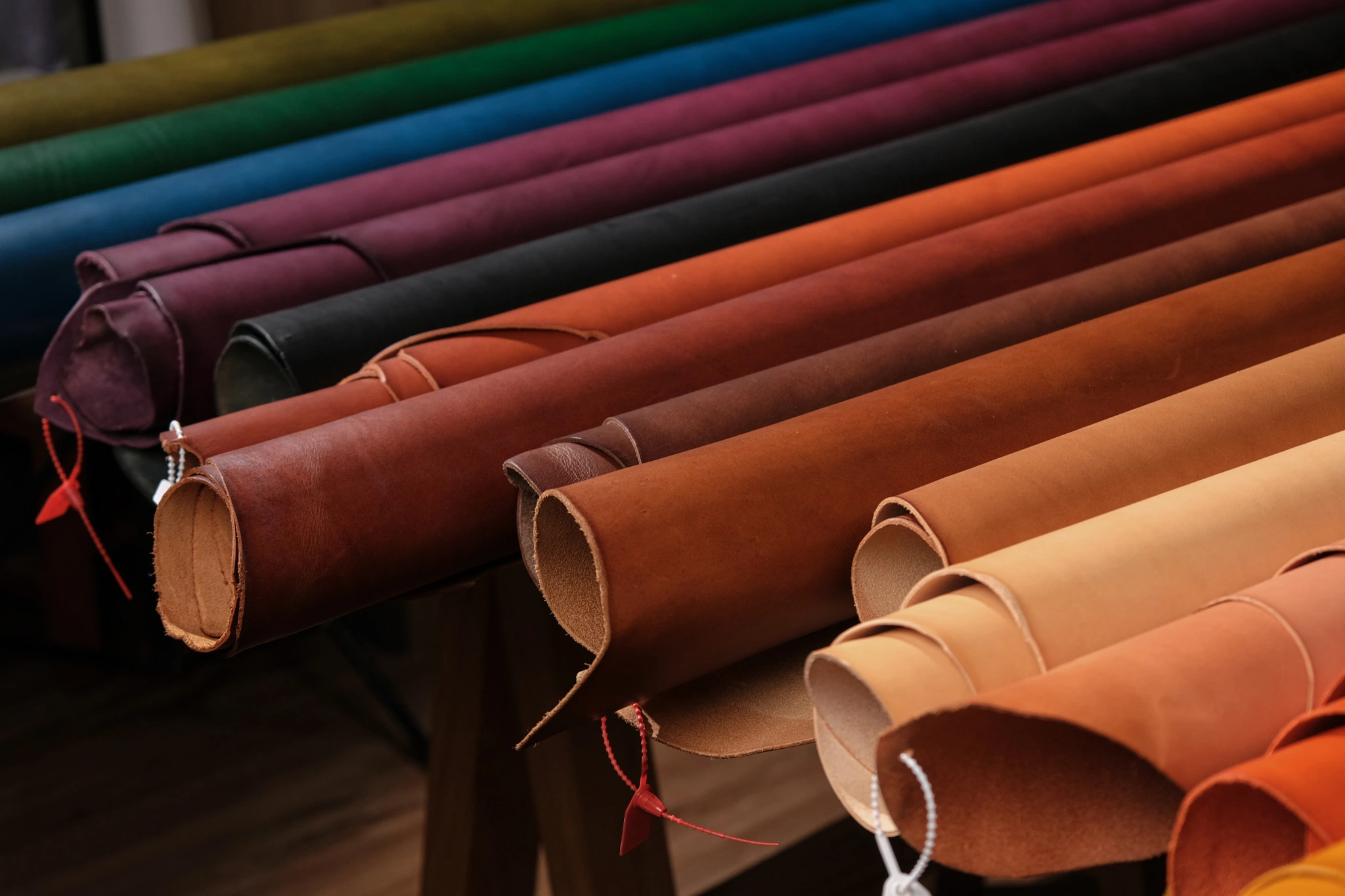
Veg-tan develops a patina with handling; chrome-tanned leather holds its color, comes soft, and needs minimal care. The trade-offs, which to pick for each build — Kit sells both tannages by the hide.
The simplest difference: vegetable-tanned leather changes over time and with the user's touch; chrome-tanned leather stays almost exactly as it was when you bought it. Neither method is superior to the other; there is only the method suited to what you are making. The real question is: do you want the item to age alongside the user, or do you want it to stay the same?
What tanning is, and where the two methods part ways
Fresh hide left on its own decomposes. Tanning is introducing a substance into the hide that binds to the fibers so it stops decomposing and becomes a material that lasts for decades. Which substance you choose to introduce — that is where the two paths diverge.
Vegetable tanning (veg-tan) uses tannins extracted from plants: tree bark, wood, leaves. The hides sit in tannin vats for weeks, moving gradually from low to high concentrations. Tannins bind to the fibers and remain inside the body of the leather — this single sentence explains almost everything you see afterward: the hide is dense and firm, the cut edge shows color penetrating into the core, the leather can still absorb oil and water, and it continues to change in the hands of the user.
Chrome tanning uses chromium salts in tanning drums, taking about a day. After that, the leather is dyed and mostly gets a finish coat on the surface. The result is a supple hide with good drape, color that stays put, and hides that are noticeably more uniform. This is also how most leather on the market today is tanned.
A difference of weeks compared to a single day is a difference in workshop time, which is why veg-tan leather is usually more expensive. More expensive because it takes time, not because it is better — those are two different things. That is all the chemistry Kit will cover; the rest of the article is about what you can hold in your hands.
Veg-tan leather: what you gain and what you give up
In Kit's warehouse right now, there are 12 vegetable-tanned lines: Buttero, Pueblo, Camouflage, Alaska, Minerva Box, Chevre PatNat, Waxy, Mozart, Dollaro, Minerva, Sully Tuning, and Hatch. Sully Tuning in particular, although part of Alran's Sully family, is purely vegetable-tanned (about 1.1–1.3 mm thick), unlike the combination-tanned Chevre Sully in the section below. Most of these lines share the following strengths.
- Darkens and develops patina with the user's touch. The leather darkens and takes on a sheen where frequently touched. Two wallets cut from the same hide, used by two people for six months, will no longer look alike. This is something no chrome-tanned leather can do.
- A natural look. Many lines leave the surface bare with no sealing topcoat, so you see the genuine character of the leather rather than a perfectly uniform surface.
- Edges burnish beautifully. Tight fibers and the absence of a barrier allow edge dye to penetrate evenly; a few rubs produce a clean shine. This is the step that makes or breaks the look of an item, and it is easiest to practice on veg-tan leather.
- Many lines hold their own shape. Buttero in Kit's warehouse is around 2.2 mm, stands up on its own, and requires no stiffening reinforcement. Hatch 2.2 mm is what Kit designates for load-bearing components: belts, straps, rigid gussets.
In return, there are a few things you have to prepare for:
- Sensitive to water when new. A drop of water falling on bare leather leaves a dark ring with an outline, most visible during the first few months when the hide is still light in color.
- Picks up fingerprints right on the workbench. Skin oils, sweat, and pen ink all become marks — hands must be clean right from the cutting stage, not just when in use.
- Needs conditioning. Not often, but occasionally: in very thin amounts, when the leather starts to feel dry and looks dull. Under-conditioning is easy to fix; over-conditioning is not.
- Usually stiffer when new. Most veg-tan lines take time in use to break in and soften — except for naturally tumbled lines like Alaska.
- Scratches show clearly in the early stages. A bare surface hides nothing. Later on, as the entire hide darkens, minor scratches blend into the background, and some marks fade with a rub of the finger.
Chrome-tanned leather: what you gain and what you give up
Also 12 lines, on the other side of the warehouse: Epsom, Togo / Odessa Calf, Nubuck, Taurillon Clemence, ostrich leather, Box Calf, Caviar, Taiga, Velvet, Evercolor, Zermatt, and EPI.
- Color stays consistent almost throughout its life. The customer receives the piece looking just like the photo, and three years later it still looks the same. For custom-order makers, this is very practical.
- Supple right from the hide. No waiting for the leather to soften; the piece conforms to the hand right from the very first one.
- Low maintenance. Wipe it clean, without worrying about water rings or scheduling conditioning sessions.
- High consistency across hides. Ten items of the same pattern turn out identical — critical when making production runs. Epsom is also the line with the widest color selection in the warehouse's chrome category.
- Certain embossed groups still hold their shape. Epsom, Caviar, and Taiga 2.2 mm yield crisp edges without reinforcement, so "chrome is always floppy" does not apply to the whole category.
And where chrome cannot deliver:
- No patina. An item made today and three years from now will look almost identical. For someone who wants to watch leather age and change, this is a dealbreaker; for someone who wants the piece to keep its original look, this is exactly what they seek.
- Edges are harder to burnish to a high shine. Because the surface has a finish coat, edges usually have to be edge-painted rather than burnished for a natural shine. Another point to remember: rubbing with heat flattens the grain, and once flattened, it will not bounce back.
- Lacks a raw, rustic feel. The surface is so clean and uniform that anyone looking for a rustic character may find it a bit sterile.
- Napped leathers are an exception to maintenance. Nubuck and 1.8 mm Velvet feel like velvet to the touch but absorb water and collect dirt, requiring a waterproof protective spray before use and regular reapplication.
As for the environmental impact of the two tanning methods: you will read many firm claims pointing in both directions. Kit does not have factory data on hand and will not write about it here, rather than picking a side just to make selling easier.
What are semi-vegetable and combination-tanned leathers?
Between the two methods lies a third category: semi-vegetable tanning, also known as combination tanning — chrome-tanned first and then retanned with vegetable tannins, or vice versa, depending on the tannery. The intention is to take something from each side: softer and more moisture-resistant than pure veg-tan, while still developing a subtle patina over time.
Kit stocks three lines. Chevre Sully — Alran goatskin with a small natural pebbled grain, thin yet tough — is also the line with the most colors in the entire warehouse. Chèvre Sully Fluo is also combination-tanned like Sully. Barenia / Novonappa develops the clearest patina in the calfskin category. If reading the two sections above leaves you conflicted with both, this is the group you should look at first.
Looking at a hide, how can you tell which tanning method was used?
Four observable signs, ranked by reliability:
- Fold a corner. Most veg-tan leather still retains resilience: the fold creases slightly and springs back, and the hide can stand on edge. Chrome leather drapes softly and collapses in your hand — except for the embossed, structured group.
- Smell it. Veg-tan leather smells of dry grass and tree bark, slightly astringent with a mildly sweet finish, most noticeable when the leather warms up. Chrome leather almost entirely lacks this scent.
- Drop a bead of water — on a scrap piece, never on the hide you plan to use. Bare leather absorbs it immediately, leaving a dark ring that stays for months; on finished leather, water beads up and wipes right off.
- Check the cut edge. Veg-tan leather shows color penetrating the body, with the core sharing the same warm tone family as the surface. Many chrome hides have a core that is lighter and cooler than the surface. This sign is only an indicator, not definitive proof — quite a few chrome hides are also struck-through (dyed through).
Whenever you are not sure, do not guess. Veg-tan lines that have been tumbled soft or stuffed with wax blur all these signs, while semi-vegetable leathers sit right in the middle, making them impossible to identify by eye alone. Asking the seller is fastest — and this is where Kit states it upfront: every line clearly states its tanning method, browseable by category under vegetable-tanned, chrome-tanned, and semi-vegetable. If a seller cannot tell you the tanning method of the hide they are selling, you should stop there.
Which item should use which type?
- Items you want to age gracefully over the years — pocket wallets, watch straps, notebook covers: choose veg-tan. Buttero if you want color to change slowly and evenly on a smooth surface; Pueblo if you want a rough surface that burnishes into a sheen over time, the most pronounced change in the warehouse.
- Items that must maintain their exact color with minimal care — everyday bags, gifts for people who have never looked after leather, production items that must look identical: choose chrome. Epsom when you need structure and batch cutting; Togo / Odessa Calf when you want a raised pebbled grain and a softer profile.
- Items that must be thin yet tough — multi-compartment wallets, interior linings: Chevre Sully, folding into multiple layers without adding bulk.
- Items frequently exposed to rain that still need a natural feel: wax-stuffed lines like Waxy — water beads up on the surface, giving you time to wipe it off.
- Thick, load-bearing items: Hatch 2.2 mm if taking the veg-tan route, Taiga 2.2 mm if you want embossed chrome.
Which type should beginners start with?
Buttero — for very practical reasons, not because it is "better." Its tight fibers allow blades to cut clean and straight: you immediately see where your cut drifted off, something that supple, draping leather hides. Edges burnish up in a few strokes, so you get to practice the trade's most finicky step on the most forgiving leather. At around 2.2 mm, the hide holds its own shape, cutting out an entire layer of reinforcement work.
A smooth surface also reveals crooked stitching. It might sound like a drawback, but when learning, seeing your mistakes is a good thing.
If your first project is a soft, unstructured bag, or a piece that must keep its exact color as a gift, going with chrome is not a mistake — just know that you are trading patina for consistency. Embossed leathers forgive cutting flaws better, because the raised grain scatters light reflections so friction marks do not show as shiny streaks. The one thing both paths demand: a very sharp knife.
Is veg-tan really more durable than chrome?
Not necessarily. Durability is a matter of the hide's fiber structure and how it is used, not the tanning method. Whether a piece is cut from the bend (back) or the belly, its thickness, tight or loose fiber structure, stitching thread, and how the user treats it — those factors dictate how long an item lasts. A belt cut from the belly of a veg-tan hide will still stretch and its prong holes will still pull out of shape; a thick chrome hide cut properly from the bend will hold up for years.
What is true, and often exaggerated into "more durable," is that bare veg-tan leather is easier to repair: a scratch is simply displaced fibers, and rubbing it can smooth it out. Finished leather, once its topcoat is gouged or peeled away, cannot be rubbed back. Being easy to repair and being durable are two different things. On the flip side, chrome handles moisture better — an item frequently caught in the rain without regular care will last longer if made from chrome leather.
Is chrome-tanned leather genuine leather?
Yes. This is the most common misconception around this topic. Chrome tanning is a method of tanning animal hides, not a synthetic material — and it is how most genuine leather in circulation is tanned.
The line that actually matters is not between vegetable-tanned and chrome-tanned, but between genuine leather and synthetic materials. Faux leather has an unnaturally uniform surface, cut edges reveal a woven fabric backing or a core noticeably lighter than the surface, and it has almost no smell. The best safeguard remains asking for provenance: every line at Kit clearly states which tannery made it, and asking about that is standard practice.
Does veg-tan leather get ruined immediately if it touches water?
It does not ruin, but it leaves a mark. Water absorbs into the leather and dries into a dark water ring with an outline — the leather does not rot or disintegrate, but the surface gains another mark.
If it happens, do not dab dry only the wet spot; dabbing only sets the ring's edge harder. Dampen the entire section evenly with a slightly damp cloth so the water ring dissolves, then lay it flat to dry at room temperature. Do not blow-dry with heat, and do not leave it in direct sunlight — high heat is what truly ruins genuine leather. The mark will fade into an even area, then gradually blend in as the entire item darkens.
If an item is certain to face rain, choose a wax-stuffed line from the start, or go with chrome entirely. Again, it comes down to matching how the item will be used, not choosing which side is "better."
Selecting & buying leather at Kit Leather
Kit states the tanning method for every line and stocks both types in the same warehouse — 12 veg-tan lines, 3 semi-vegetable lines, 12 chrome lines — so there is no reason to steer you toward one side. Leather is sold by the hide: for each hide you can see its exact area, thickness, color, and price, so you can calculate your blanks before buying.
Want leather that transforms over time: view Buttero hides → or Pueblo hides →. Want color that stays put with minimal care: view Epsom hides → or Togo / Odessa Calf hides →. Need thin yet tough leather: view Chevre Sully hides →. If you are not sure which one you need, message Zalo and tell us what you are making — Kit will help you evaluate.