
What is ostrich leather? Quill follicles and how to cut for proper placement
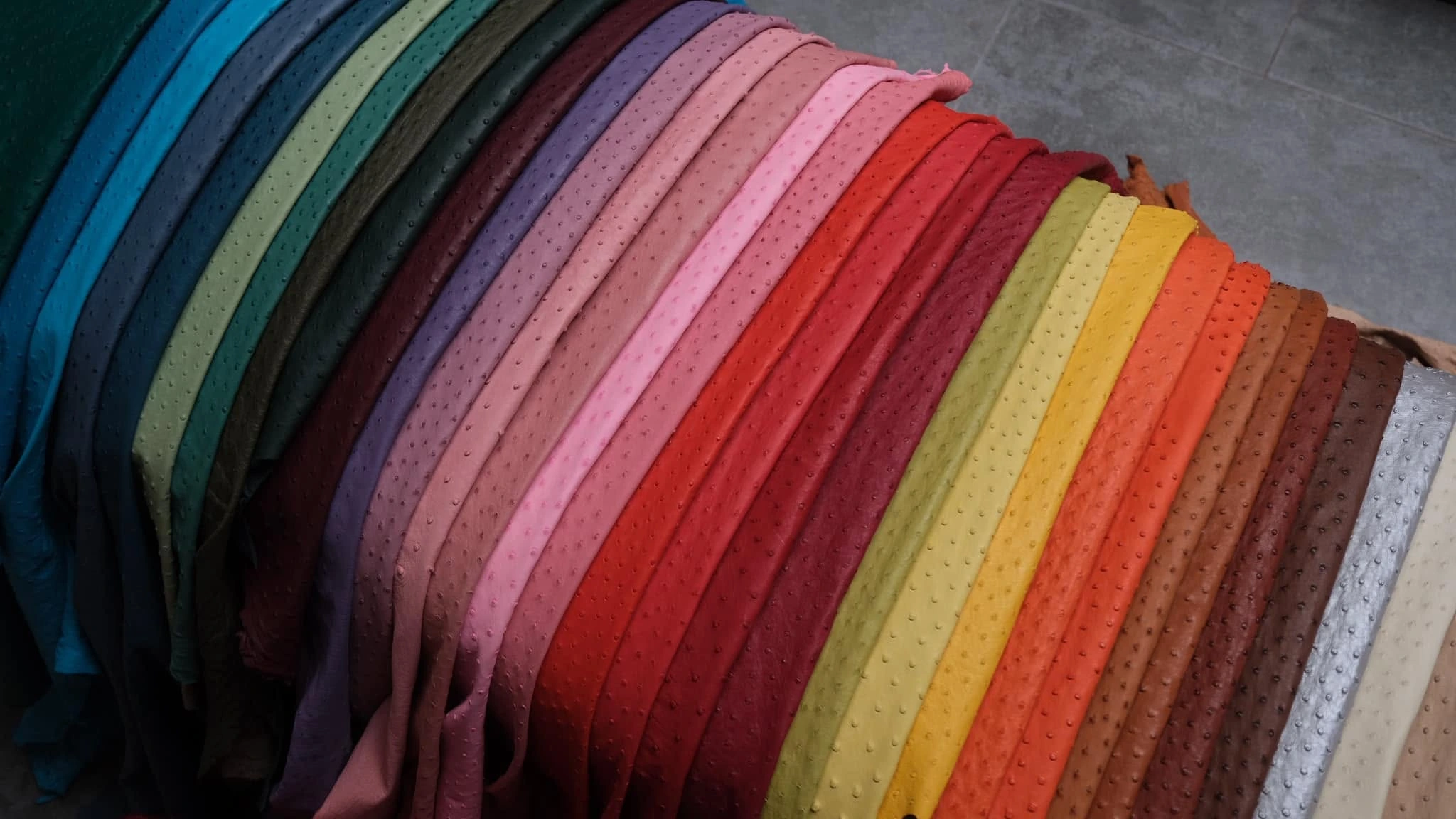
Ostrich leather is recognized by its raised quill bumps, concentrated along the spine rather than uniform across the hide. How to spot genuine quills and what to make with it — view hides at Kit Leather.
Ostrich leather is tanned leather from farmed ostriches, immediately recognizable by the raised round bumps on the leather surface — quill marks, where feathers were once attached. Kit imports from Klein Karoo (South Africa, 1970), chrome-tanned. Soft, tough, with a luxurious look that embossed leather struggles to replicate — suitable for wallets, bag panels, and watch straps.
Where quill marks are located on the hide
This is where almost every article online gets it wrong, because they only look at finished goods.
The quills are not evenly distributed across the hide. They are concentrated along the spine, largest and densest in the center of the back and then thinning out toward both flanks. Moving up toward the neck, the quills get smaller. The rest of the hide is almost smooth, with only faint pores remaining.
Why do people often say quills are evenly distributed? Because wallet and bag sellers only see pieces cut from the back area — to them, even quills are taken for granted. Only someone holding a full hide sees that the hide has prime areas and plain areas.
How to inspect a hide to tell if the quills are real
Genuine versus fake is the biggest concern when buying ostrich leather, yet it is easier to check than many people think — if you know where to look.
- Real quills have a hole in the center: that is a real pore, where the feather was once attached. Embossed bumps are raised but solid, with no hole.
- Real quills slant: they slant in the direction of the feather rather than standing perpendicular to the leather surface. Machine-embossed bumps are usually unnaturally square and uniform.
- Real quills vary in size: larger along the mid-back, smaller toward the edges and up the neck. That very imperfection is the proof.
From that, here is a practical tip when shopping for finished goods: a wallet where quills are perfectly uniform everywhere is suspicious — it is either ostrich-embossed cowhide or pieced together from multiple back sections. Real body leather cut from a single hide always has areas with denser quills and areas with sparser quills.
Also, do not confuse ostrich leather with Caviar leather: Caviar has round pebbles, but it is an embossed grain uniform across the surface, with no central hole and no size change across areas.
Is ostrich leather durable?
Durable, and more durable than its soft appearance suggests. Ostrich leather fibers are cross-woven, so they withstand tensile stress and repeated folding well; the surface has many pores, making it breathable and less prone to mildew during prolonged storage.
You will hear many claims that ostrich leather is "five times more durable than cowhide." This number is repeated everywhere, but Kit has not seen any source cite a test or standard, so take it as a figure of speech to visualize, not a measured metric. What is more certain: a daily-use body-cut wallet will not crack at fold creases after years, and the raised bumps help disguise scuffs on the leather surface.
Why leathercrafters favor ostrich leather
- A luxurious look hard to replicate: raised bumps with real holes cannot be matched by embossed leather — looking at the finished piece, one immediately recognizes the leather.
- Soft yet tough: it drapes naturally in hand, making beautiful soft bags, yet it does not break down with repeated folding.
- Two looks on one hide: the quill back area shows off texture, while the smooth area can be used for linings, straps, and secondary parts — if you plan your cutting layout well, little goes to waste.
Drawbacks and usable yield of the hide
The biggest drawback is not in the leather quality itself, but in the cutting layout calculation. If your item requires quill bumps on every part, you can only use the back area, which is just part of the hide — you have to buy extra, and the cost per component increases significantly compared to a simple area calculation. A sensible approach is to accept cutting some parts from the smooth areas.
Two more points: the leather is soft, so items that need structure must be reinforced; and applying heat and pressure flattens the quill bumps, and once flattened, they do not recover — be careful during edge finishing and creasing steps.
Cutting and crafting: place templates on the hide first
Because quill size changes by region, two adjacent panels taken from distant sections will have different grain patterns, looking like two different leathers. A good habit: place all patterns on the hide, inspect, adjust until satisfied before cutting. Reserve the mid-back for the most prominent parts.
For edge finishing, use hand friction and avoid high heat near quill areas. Seeing flattened quills on an item on the market is a sign of immature craftsmanship.
How does ostrich differ from Caviar, Togo, and crocodile leather?
Compared to Caviar leather: both have a "pebbled" surface, but Caviar has an embossed grain uniform across the hide, so cutting anywhere yields the same look; ostrich has natural quill bumps that are irregular, requiring area alignment. Compared to Togo leather: Togo has pebbles covering the entire leather surface (with no smooth areas like ostrich) and has a firmer structure, but the pebbles vary in size so you still have to plan when cutting; ostrich is softer, drapes more, and has a more luxurious feel.
As for crocodile leather — which people often compare it to: crocodile has larger scales, is firmer, and holds its shape better; ostrich is soft, lightweight, and more comfortable over prolonged use. In terms of paperwork, ostrich is farmed and not in the strictly restricted category like crocodile leather, so buying and selling is easier.
What items look best in ostrich leather?
Best suited for small items that showcase the leather surface: wallets, cardholders, bag panels, watch straps, passport covers. Larger soft-structured items like totes are also possible, but you should anticipate that most of the surface area will come from the smooth sections.
Does ostrich leather darken over time?
Yes. With prolonged use, the leather softens further, darkens slightly, and gains a sheen where hands frequently touch — each piece develops its own character according to its user, especially on lighter tones. Do not expect a dramatic shift in tone like the patina of vegetable-tanned leather; with ostrich leather, the most noticeable change is the leather surface mellowing and the quill bumps gradually turning glossy. If you want leather that changes color dramatically and faster, look at Pueblo leather or vegetable-tanned lines.
Storing hides and finished items
Unused hides: roll loosely, do not fold — creases across quill areas leave marks that are difficult to salvage. Store in a dry, ventilated place away from direct sunlight, and do not place heavy objects on the quill back area. Ostrich leather is breathable so it rarely mildews, but it still needs to stay dry.
Finished items: wipe off dust with a soft dry cloth, paying attention to crevices around the bumps where dust tends to settle, especially on light colors. If wet, blot dry immediately and air-dry naturally; do not use hot hair dryers. The leather is chrome-tanned with a finish, so it does not require periodic oil conditioning like veg-tan leather.
Choosing and buying ostrich leather at Kit Leather
Kit sells ostrich leather by the individual hide, priced per pia (30×30 cm) — each hide shows its exact surface area, color, and price, so you know in advance how much back area you have to work with. If you want to buy ostrich leather, click View available ostrich hides in stock → to choose a hide, or message via Zalo so Kit can help check which hide has quill areas suitable for what you are making.