
What is Pueblo leather? Its rough surface and how it develops a sheen
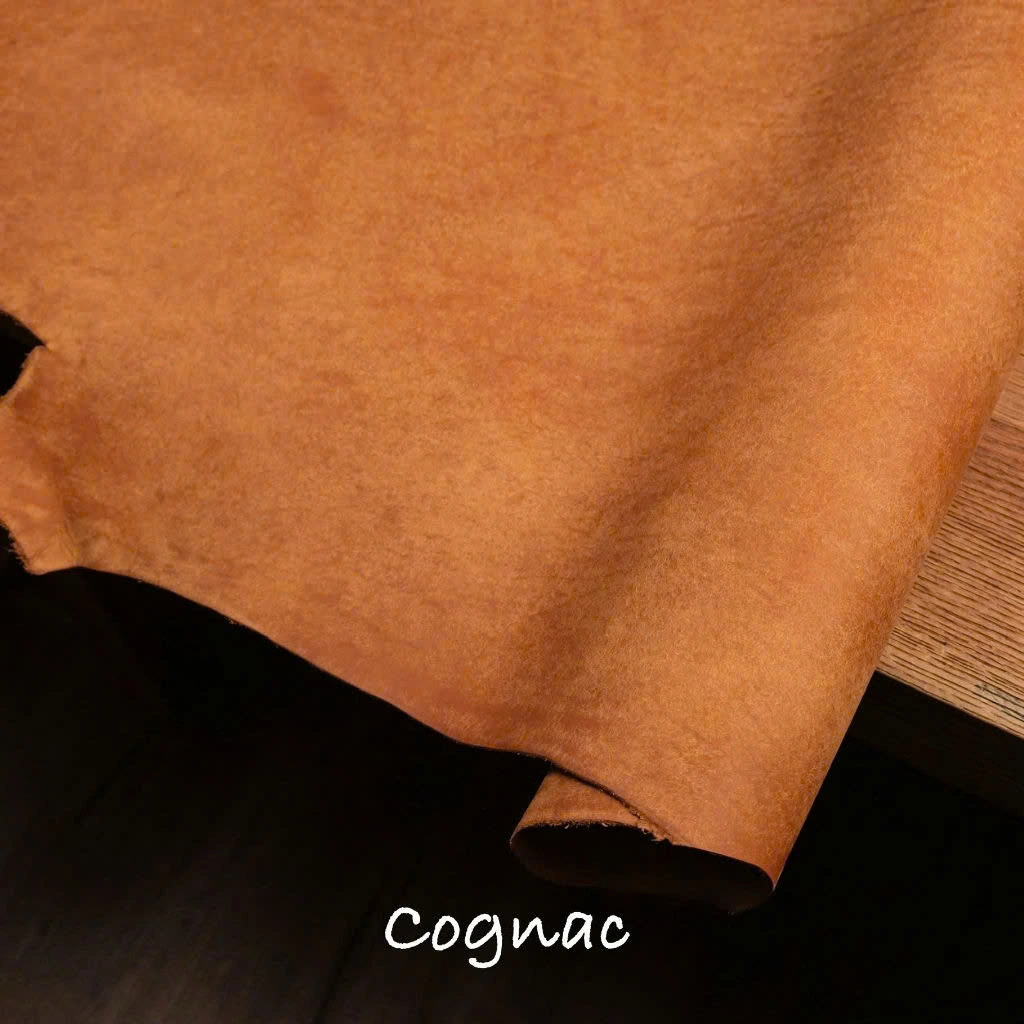
Pueblo is an uncoated, textured vegetable-tanned cowhide that darkens and develops patina through handling. How long it takes to patina, choosing colors, and how it compares to Epsom and Waxy — browse hides at Kit Leather.
Pueblo leather is vegetable-tanned cowhide, left unfinished without a coating film, with a matte, rough surface like very short-nap velvet and a slight grip to the hand. This leather line comes from the Badalassi Carlo tannery in Tuscany, Italy. The more it is handled, the more the rough surface gets burnished flat, darkens, and develops a glossy patina — each item takes on its own look, impossible to replicate.
Identifying characteristics of Pueblo leather
Three senses tell the same story. Touch: rough with a slight grip, not slippery like coated leather — like velvet with very short fibers, enough for your fingertips to feel resistance. Look: a matte surface with almost no reflection; rub your palm across it once and the rubbed spot immediately darkens and turns glossier. People seeing the hide for the first time often mistake it for flawed or unfinished leather — that rough surface is intentional, and the whole reason people choose Pueblo.
Smell: a new Pueblo hide has a warm herbal scent, slightly woody and mildly astringent like tree bark — the smell of vegetable tannins, not the harsh smell of chemicals. There is another test Kit advises you not to do: dropping water on the leather's surface. It really soaks in, and the test spot will stay there for months.
How Pueblo is tanned
The foundation of Pueblo is vegetable tanning: using plant tannins instead of chromium salts, measured in weeks rather than a single day. You trade speed for this — the leather retains the ability to keep changing in the user's hands, something chrome-tanned leather lacks. After tanning, the hide is not coated with a film, with no surface paint sealing it: that is why it absorbs skin oils, takes in water, and shows finger marks immediately.
As for how that rough surface is produced, Kit will say frankly that we are not sure. Different sources describe it differently: some say the surface is buffed with a brush or rotary tool, while others claim it is not buffed at all. Kit handles the hide rather than standing in the tannery, so we only speak to what can be verified: what you get is a rough, matte surface without a barrier film. For a maker, the result matters more than the process — and the result is clear.
What tannery is Badalassi Carlo
Badalassi Carlo is a vegetable-tanning tannery in Tuscany, Italy — Italy's historic vegetable-tannin region — and has been producing the Pueblo line for over four decades. In Kit's stock, there are four leather lines from this tannery: the same tannage, differing in the surface finish. Pueblo has a raw rough surface, Minerva has a smooth oil-rich surface, Minerva Box is milled in drums to bring out pebbled grain, and Waxy is infused with wax. Four names, one root — see more on the Badalassi Carlo tannery page.
Why leather crafters favor Pueblo leather
- The leather records the journey of use: fold lines, finger pressure spots, and pocket edge contact points all leave their mark. Two wallets cut from the same hide, used by two people for six months, will not look alike.
- Changes more visibly than smooth leather: the rough surface absorbs hand oils quickly, so crafters see their work payoff sooner.
- Glossy areas beside remaining rough areas: this transition on the same item is something smooth veg-tan leather does not offer.
How long before Pueblo leather develops a patina?
There is no universal timeline, and this is where Kit wants to be clearer than most of what you read. Descriptions out there range from "changes visible in a few weeks" to "around three months for a slight sheen, a year before the color looks distinctly different." Both can be true, because what decides it is not time, but the number of times hands touch the leather.
A pocket wallet pulled out dozens of times a day: after a few weeks, the spots where fingers regularly press already look glossier than the rest, after a few months the tone warms up noticeably, and around a year in, setting it next to an unused scrap from the same hide reveals just how far it has come. With that same wallet used once or twice a week, all of those milestones stretch out several times over. An item left in a closet barely changes at all — untouched leather stays dormant. This is the honest answer, even if it is not convenient for sellers.
Scratching also has two stages — don't just listen to half the story. Early on, scratches show clearly because the surface is still rough and the base is still light — a single fingernail mark is visible. Later on, once the surface has burnished flat and the whole hide has darkened, small scratches blend into the background, and some marks fade noticeably just by rubbing with a finger. Some sources only tell the second stage, making it sound like the leather self-heals; in reality, you have to go through the early stage first.
Does Pueblo leather absorb water?
Yes, and quickly. Without a protective coating, a dropped water droplet absorbs immediately, leaving a dark water ring with a sharp edge. This ring fades gradually as the whole hide darkens, but in the first few months, it remains very visible.
Once a water stain happens, do not dab only the wet spot dry — the more you dab, the sharper the ring sets. The best remedy is to dampen the entire leather panel evenly with a slightly damp cloth to dissolve the ring, then lay it flat to air-dry at room temperature, without hot air or direct sunlight. The mark will soften into an even shade rather than a sharp ring. For items frequently exposed to rain, from the start it is better left to Waxy leather: from the same tannery, with wax so water beads up, giving you time to wipe it off.
Drawbacks of Pueblo leather
- Hands must be clean, no exceptions: the leather takes finger marks right on the workbench, without waiting until it is in use. Hand oils, sweat, and pen ink all leave marks.
- Burnishing edges requires multiple passes: loose surface fibers mean the edge does not clean up immediately like smooth leather.
- Difficult to re-dye evenly: the rough surface absorbs dye unevenly; touch-up color in one spot often shows up more than leaving it alone.
- Knives dull faster: the high friction of the rough surface dulls the blade sooner than cutting smooth leather of the same thickness. Strop your blade more frequently, and do not try to finish a cut with a blade that already drags.
- Dust settles into the surface texture over time: the uneven surface lets dust settle in low spots, most visible on light colors. Nothing is damaged, but it does need brushing off.
- Light colors show water spots the most: on natural or cognac, a single drop leaves a very distinct mark.
- Wasted on items left in a closet: leather that is not touched stays dormant and develops nothing.
How Pueblo differs from Waxy, Buttero, and Nubuck
Compared to Waxy leather, from the same Badalassi Carlo tannery: Waxy is infused with wax so water beads up, giving you time to wipe it, and light scratches fade with hand rubbing; Pueblo absorbs water immediately, but its surface undergoes the most dramatic transformation. Compared to Buttero leather: Buttero has a smooth grain, dense fibers, holds its shape, and takes an edge easily — the line Kit points beginners toward; Pueblo is for makers who can already cut a clean straight line.
Meanwhile, Nubuck leather only resembles Pueblo in the description "velvet-like." Nubuck is chrome-tanned leather buffed on the grain side: it must be sprayed with a water repellent before use and reapplied periodically, and it does not develop a patina. Pueblo is not sprayed; in exchange, you accept the marks — and get color that shifts over time.
How Pueblo differs from Epsom
These are two opposite ends of the stock, so comparing them helps you choose quickly. Epsom leather is chrome-tanned calfskin with an embossed hatched grain that holds its structure; Pueblo is vegetable-tanned cowhide left raw, softer and more rustic.
- Color: Pueblo darkens gradually and develops a patina with your hands. Epsom retains its color for almost its entire lifespan — an item made today and three years later will look practically the same.
- Burnishing effort: Pueblo requires multiple passes to achieve a clean edge. Epsom has an even embossed grain, so the edge comes up faster and more consistently.
- One piece or production runs: Epsom cuts the same anywhere on the hide, and ten pieces of the same pattern will turn out identical — practical for batch production. With Pueblo, every hide has its own character and each piece has its own look: strong for bespoke work, challenging when a client demands two identical pieces.
- Water and fingerprints: Epsom wipes clean with no fear of water rings. Pueblo requires keeping hands clean both during crafting and in use.
In short: choose Pueblo when what you want to sell is time; choose Epsom when what you need is structural stiffness and uniformity. Kit sells both, so there is no reason to lean toward either.
Pueblo color palette: choosing colors for different items
The color range in stock changes with each lot, but making a choice always comes down to two factors: how visible the patina is, and how careful you need to be.
- Light tones like natural or cognac: showcase patina most clearly, and are also the most prone to water spots and fingerprints. Choose these for people who enjoy watching leather change and aren't afraid of marks.
- Dark brown tones and deep colors: patina develops more subtly, but water marks and dust are practically invisible. Choose these for everyday wallets and for customers who have never used raw veg-tan leather before.
- Combining two tones on one item: use a light tone on the exterior to show off the color change, and dark tones for linings and high-wear components.
Photos never capture colors completely accurately, and Pueblo darkens from the very first weeks — so check the photos of the actual hide on the Pueblo hides page.
What to make with Pueblo leather?
Best suited for everyday-carry items, because only when handled regularly does the surface have the chance to change.
- Watch straps: one of the most common Pueblo projects. In constant contact with skin and sweat, they change fastest, and needing only narrow strips makes good use of hide edges.
- Pocket wallets and cardholders: classic choices. A cardholder after a few months in a front pocket: the exterior has developed a patina while the inner slots still keep their original rough texture.
- Notebook covers: large, flat panels of leather, opened and closed by hand every day — hand marks gather along the edges where it opens.
- Bags and large cases: large panels display patina beautifully, but because the leather is soft, structured pieces need reinforcement, and every water spot is proportionally larger — darker tones are advisable.
Caring for Pueblo during crafting and after completion
During crafting: keep hands clean and dry, do not keep water cups on the workbench, and place uncolored paper under the leather. Once cut, face the leather sides toward each other, do not let the grain side rest on a workbench with machine oil. For unused hides, roll them loosely, do not fold — folds on raw veg-tan leave light crease marks that are difficult to fix — store in a dry, well-ventilated area away from sunlight, as sun causes uneven darkening.
After completion, the most important rule is do not condition right away. For the first few months, let the leather absorb oils naturally from the user's hands; applying cream or oil at this stage only darkens the color prematurely and unevenly. Once the leather has darkened and starts to feel dry — rougher to the touch, looking dull — then apply conditioner: a very thin coat, rubbed evenly over the entire piece rather than spot-dabbed. For daily-use items, once or twice a year is sufficient. Under-conditioning is easy to fix; over-conditioning is not.
Selecting & buying Pueblo leather at Kit Leather
Kit sells Pueblo leather by the hide — each hide is unique, showing the exact area, thickness, color, and price of that specific hide, so you can calculate your blanks before buying. To buy Pueblo leather, click See in-stock Pueblo hides → to choose a hide, or message via Zalo so Kit can help find which hide and color suits the project you are making.