
What is Epsom leather? The most structured calfskin, holding box shapes without stiffeners
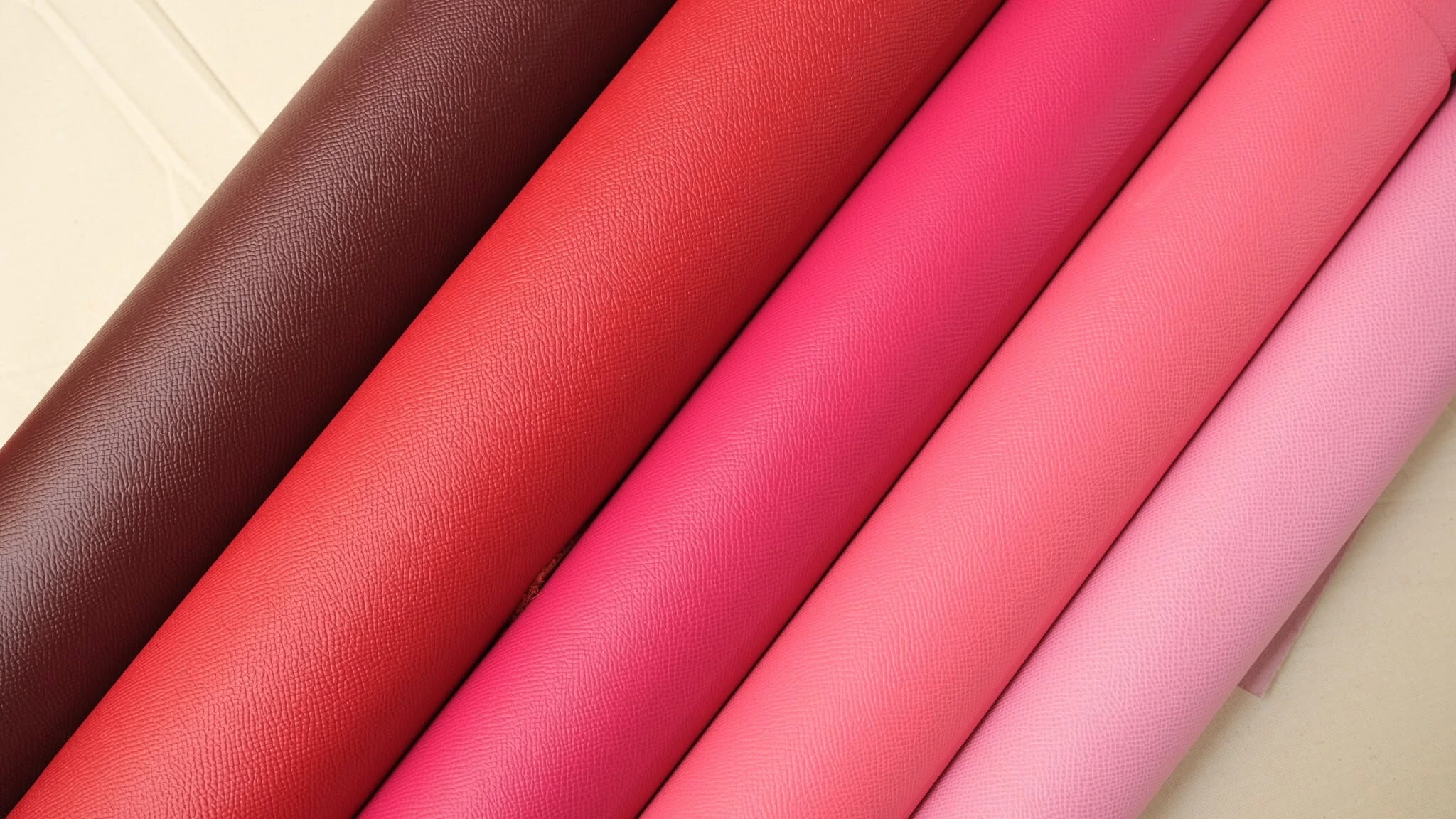
Epsom is an embossed finish on calfskin, not proprietary to any fashion house. Structured without stiffeners, hides scratches, develops no patina — browse hides at Kit Leather.
Epsom leather is chrome-tanned calfskin embossed with a small cross-hatch grain—a finish that yields the most structured hide among calfskins. Kit's hides are imported from Weinheimer tannery (Germany, founded in 1849), a tannery specializing in chrome-tanned calfskin. The cross-hatch grain holds a boxy shape almost without lining, and hides scratches very well.
Identifying characteristics of Epsom leather
Across the entire surface are small, perfectly uniform cross-hatched grain cells—embossed with a mold, so every cell is identical, with no variation between prime and ordinary grain areas. To the touch, the texture feels evenly ridged yet firm. The quickest tell is that the hide stands on its own: propped up, it holds its shape rather than slouching like soft leather.
Why is it called Epsom, and does only Hermès have it?
The name does not come from a tannery, but from a town: Epsom in southeast England, famous for its racecourse. The product page of Hermès—the fashion house that made the name famous—states exactly that, and clearly refers to this as a machine-embossed grain.
A simple way to understand it is this: Epsom is not a leather breed, but a finish. What is proprietary is a specific brand's own leather—which tannery they contract with, which colors, which standards—not the grain pattern itself. Many tanneries in France and Germany produce this grain and sell it under their own commercial names.
Therefore, when buying hides, the right question is not whether it is Epsom, but which tannery made this hide. Name discrepancies are normal: the Togo line at Kit is marked on the hide as Odessa Calf. Kit's Epsom hides come from Weinheimer, which also produces the Box Calf and Togo in stock.
Epsom leather base: calfskin or cowhide
Sources contradict each other here, so Kit speaks candidly instead of picking a side at random. Some sources call Epsom calfskin, some call it Epsom cowhide outright, and others say either calf or cow is fine.
A clear understanding sticks to the definition itself: Epsom is an embossed finish, so in principle it can be stamped onto various base leathers. The standard base for this line is calfskin—fine fiber, clean grain, uniform thickness, taking sharp embossed patterns—but there are versions made on cowhide, which look very similar in photos. For Kit's hides, there is no need to guess: calfskin from Weinheimer.
How to tell genuine Epsom leather from Epsom-embossed cowhide
This is a question leathercraft makers ask when buying hides, yet almost no article answers it—because most articles about Epsom are written for bag buyers, not for the person holding the hide. Four things to inspect:
- Ask for the tannery, not the grain name. Epsom is the name of a grain pattern, not a certificate. A reputable seller can always tell you which tannery and which country the hide comes from.
- Hide size. Calfskin yields small hides. If a hide is as large as half a mature cow, the base is cowhide, no matter how similar the grain looks.
- Inside the grain cells. Inspect at an angle under light: if the base retains the full grain surface, you can still see fine pores inside each cell; if the base was buffed smooth and coated with a thick film, the inside of the cell is as glossy and smooth as plastic.
- Cut edge. Calfskin has fine, uniformly dense fibers; cowhide fibers are coarser. If the leather has a thick coated film, a distinct layer sitting on top of the leather will be clearly visible on the cut cross-section—that is the film layer, not leather.
And a hands-on test: fold the hide. Epsom is structured, and the fold crease stands up sharply; soft film-coated leather wrinkles limply, and sharp folding may even reveal micro-cracks in the film.
Why leathercrafters favor Epsom leather
- Holds structure without lining: cutting a single layer of leather lets the item hold a boxy shape on its own, eliminating an entire sequence of stiffener application—selecting firmness, bonding evenly, finishing two-layer edges—and removing a potential point of delamination after a few years.
- Hides scratches well: the grain cells diffuse reflections so scratches do not show as bright lines; everyday items still look new.
- Uniform cutting everywhere: the grain is consistent, so there is no need to avoid flawed areas; pieces of the same pattern turn out identical, and adjoining panels align seamlessly—very practical for commercial production.
Disadvantages of Epsom leather
The trade-off for being structured is that it has no drape: making a slouchy tote out of Epsom leaves the bag looking like a box. Because the leather is stiff, folding it sharply in the wrong spot leaves a permanent crease—on Epsom, once a crease is stamped in, it stays. Three more points to consider before prototyping:
- Multiple layers add bulk—overlapping areas must be skived, or the piece will bulge.
- Applying heat and pressure flattens the grain, and once flattened it does not recover—be careful during edge finishing and creasing. This is the most common mistake on items made with embossed leather.
- Edges must be painted. Chrome-tanned leather cannot be burnished raw to a shine like veg-tan leather, so edges must be finished with multiple coats of edge paint. It is not inferior, just a different technique.
If you want drape while retaining pebbled calfskin, check out Togo leather.
Does Epsom leather absorb water?
It resists water better than most leathers, but it is not waterproof. You will read three different claims in three different places, ranging from water-resistant to simply wiping it dry—so Kit reasons based on its actual structure.
Three layers combine: chrome tanning prevents the leather fibers from reacting violently with water like veg-tan leather, leaving no dark water rings and no stiffening; the pigmented finish on the surface causes water to bead up so it can be wiped away; the embossed grain prevents moisture marks from spreading into noticeable blotches.
Where water enters is not the grain surface, but the cut edges, needle holes, and flesh side—areas without a protective finish. Raindrops on the bag's exterior can simply be wiped dry; soaking in water or staying wet for a long time will still penetrate and leave marks. And since the finish is what shields the leather, any scratch deep enough to reach the base leather loses that protection.
Handling scratches on Epsom items in use
Distinguish between two types of scratches before doing anything:
- Surface scratches on the finish—most everyday scratches fall into this category, and on Epsom they virtually disappear to the eye because the cross-hatch grain scatters reflections. Wiping with a soft cloth and rubbing gently with a fingertip is enough.
- Scratches cutting through the finish—where the lighter base leather is visible at the bottom of the mark. This type does not self-heal: Epsom hides scratches optically rather than self-closing like veg-tan leather.
For deep scratches, a practical approach is to use a matching color cream, applying thin layers, and testing first on an inconspicuous spot. Do not use heat to iron it flat—heat flattens the grain around the scratch, and flattened grain is even more noticeable than the scratch itself. For large scratches or those in prominent spots, leave them to a leather restoration professional.
Care and cleaning for Epsom leather
Unused hides: roll loosely with the grain side out, and never fold—the leather is stiff, so creases are very difficult to salvage. Store in a dry, ventilated place away from sunlight and heat, and do not place heavy objects on the grain surface.
Finished goods: dust off with a soft, dry cloth. For heavier dirt, use a damp cloth wrung out thoroughly, wipe in small circular motions, wipe dry, and allow to air-dry naturally—do not blow-dry or expose to direct sunlight. Do not soak the leather: water offers no benefit and will only seep in through cut edges. Periodic oil conditioning like that for veg-tan leather is also unnecessary—oil cannot penetrate the finish; it will only sit on the surface and attract dust. For long-term bag storage, stuff with paper to keep its shape, store in a breathable dust bag, and avoid sealing in plastic bags.
How does Epsom differ from Box Calf and Caviar?
All three are structured calfskins that differ in surface texture. Compared to Box Calf leather—from the same tannery, Weinheimer: Box Calf has a flat, glossy surface that looks precise, but scratches show clearly and do not fade on their own, making it suitable for low-contact items; Epsom's cross-hatch grain hides scratches, staying like new under daily use. Compared to Caviar leather: Caviar's rounded pebbled grain also hides scratches but offers only moderate firmness, making it suitable for small leather goods; Epsom is the firmest, so it suits items that need to maintain their shape.
Items best made with Epsom leather
- Box bags and structured bags—plays to its strengths, eliminating the need for stiffeners.
- Wallets, cardholders, leather boxes, covers, trays—structured nature keeps corners crisp and dimensional forms intact.
- Belts and watch straps—constructed by layering over an inner core, rather than a single thick strip of leather like veg-tan cowhide belts.
- Batch-produced goods—consistent grain across hides ensures every finished piece looks identical.
Beyond leather goods, this grain is also commonly seen in upholstery and automotive interiors for the same reasons: durable under use, easy to clean, and with a uniform grain that looks neat.
Does Epsom leather develop a patina?
No. This must be clarified because some sources claim Epsom becomes shinier and more beautiful with use—that applies to unfinished veg-tan leather, not embossed chrome-tanned leather.
A patina requires two conditions: an open grain surface to absorb skin oils, and vegetable tanning for those oils to gradually darken the color. Epsom has neither—it is chrome-tanned, and its surface has a pigmented finish, so oils sit on the film rather than penetrating the leather.
What actually changes over time is something else: high-contact areas become shiny from friction, while the grain cells at corners and fold creases gradually flatten. That is wear, not patina, and it does not enhance the item's appearance. If you want to watch leather change color from handling, look at Pueblo leather or vegetable-tanned leathers.
Choosing & buying Epsom leather at Kit Leather
Kit sells Epsom leather by the individual hide—you can check the exact area, color, and grain pattern of that specific hide before deciding, rather than buying from a generic sample photo. Click View available Epsom hides in stock → to select a hide, or message via Zalo so Kit can help calculate how much leather you need for your project.