
What is Camouflage leather? Multi-tone mottling and how to cut it right
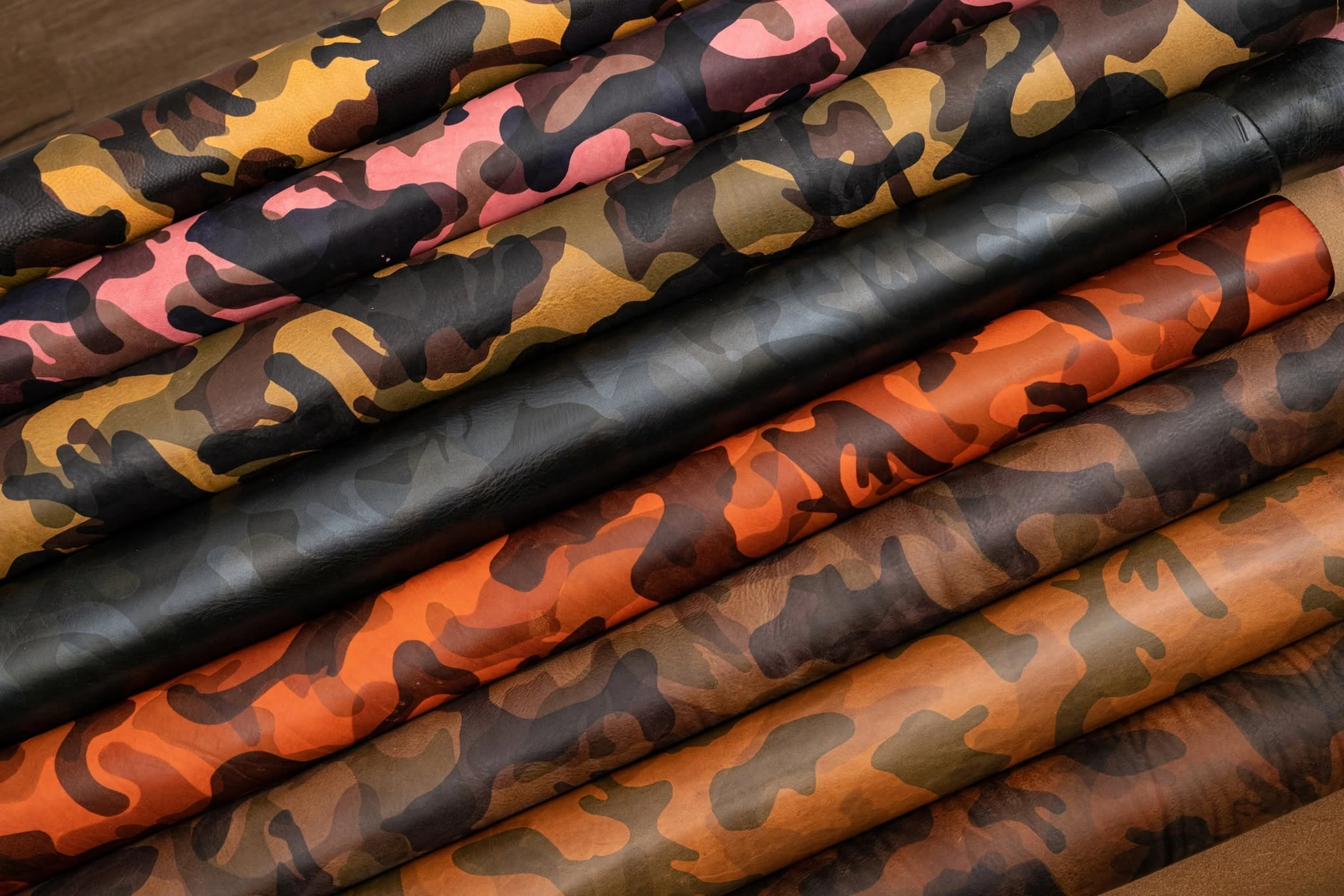
Camouflage leather is vegetable-tanned cowhide with a multi-tone mottled effect across each hide, making every piece unique. Cut large panels to show off the mottling pattern — view available hides at Kit Leather.
Camouflage leather is vegetable-tanned cowhide featuring a multi-tone mottled effect across the hide, where no two hides are alike. This leather line comes from tannery Conceria La Perla Azzurra (Italy, founded 1967). The mottling is intentional, not a dyeing defect; how you cut dictates whether the piece works or fails, so it suits large bags and notebook covers.
Identifying features of Camouflage leather
You can tell immediately: multiple color shades blend into one another across a single hide, with dark and light patches separated by soft, diffused transitions rather than sharp lines. The camo pattern is printed on a struck-through dyed leather base, with uneven printed areas so no two hides look alike—even opposite ends of the same hide differ. Beginners often mistake it for flawed dye work, but that is simply what this leather line is.
Why leather crafters favor Camouflage leather
- Every hide is unique: the printed pattern is uneven so no pattern ever repeats, making every finished item one of a kind.
- Natural visual depth: shifting shades give the leather a lively surface that flat, solid colors lack.
- True veg-tan leather: built on an untreated veg-tan base, it darkens over time as patina develops, evolving the mottling effect along with it.
Drawbacks of Camouflage leather
The biggest challenge: you cannot mass-produce identical items. If you sell made-to-order items based on a sample photo, warn customers beforehand that each piece is unique—this is a common source of complaints. Camouflage also yields more scrap because you must pattern-match your cuts around the mottling; joining two adjacent pieces can easily reveal mismatched tones. If you need solid, uniform veg-tan for production runs, look at Buttero leather.
How does Camouflage differ from Buttero and Mozart?
Compared to Buttero leather, which is smooth and uniform in color, and Mozart leather with its crisscross color grain effect: Buttero can be cut anywhere across the hide for easy batch production, whereas Camouflage forces you to select cutting areas based on the mottled pattern. Buttero is firm, easy to burnish at the edges, and suitable for learning the craft; Mozart is shoulder leather (around 13–15 sqft) or hand-worked belly leather, suitable for belts, notebook covers, and large wallets. Pick Camouflage when you want a one-of-a-kind pattern, Buttero when you need uniform color, or Mozart when you want a crisscross color grain effect.
What works well with Camouflage leather?
It works best for items with large, flat panels that allow the mottling to unfold completely: bags—maximum surface area for the clearest effect; notebook covers, laptop sleeves, document folios—broad flat planes that give the pattern room to breathe; large wallets like full-sized bifolds, where the exterior panel is still wide enough to display the color transitions. Avoid tiny pieces such as straps, logo tags, or card slots, as they only capture a single tone.
Can you use Camouflage leather for identical batch production?
No. The camo pattern printed on the leather has uneven color patches, so every hide—and even different zones on the same hide—varies, making it impossible to produce two identical pieces. If you sell from sample photos, inform customers upfront that every item is unique to avoid complaints. If you need consistent color, choose a smooth, solid-dyed veg-tan line.
Why must Camouflage leather be cut into large panels?
Because the mottled color zones are broad, only sufficiently large pattern pieces can capture the full multi-tone transition. Cut a small piece like a strap or card slot, and that piece will only land on a single flat color patch, looking like ordinary smooth leather—wasting the premium you paid for the pattern. Before cutting, lay your pattern templates across the hide to see exactly where the mottling will sit on the finished product.
Choosing & buying Camouflage leather at Kit Leather
Kit sells Camouflage leather by the individual hide—each hide is unique, showing the exact area, thickness, color, and price of that specific hide. To buy Camouflage leather, click View available Camouflage hides → to select your hide, or message us on Zalo for advice on choosing the right hide for your project.