
What is Sully Tuning leather? 1.2 mm goatskin — controlled thinness
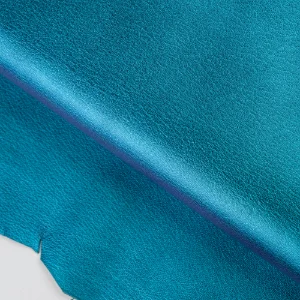
Sully Tuning is vegetable-tanned goatskin on a Sully base, calibrated to 1.2 mm thickness — predictably thin, no skiving needed. Identification, drawbacks, and best applications — browse hides at Kit Leather.
Sully Tuning leather is Alran goatskin with a distinct surface treatment and a standard thickness of 1.2 mm. A leather line from the Alran tannery (France, founded in 1903, specializing in goatskin). The 1.2 mm figure is its strength: a predetermined thinness, no skiving required — best suited for multi-pocket wallets and linings.
Identifying features of Sully Tuning leather
In appearance, Tuning looks similar to other Sully goatskin lines: the surface retains a fine natural pebbled grain, firm and full in hand yet still thin. The distinction lies in the consistent thickness of around 1.2 mm across the entire hide — holding it, it feels thinner and flatter than familiar cowhide wallets. Touching the surface reveals it has been surface-treated, not raw and rough like untreated leather, yet it still has real grain rather than being completely flat.
Why leather crafters favor Sully Tuning leather
- Predetermined thinness: having a hide ready at exactly 1.2 mm means you do not have to skive it down — the easiest step to ruin in the trade: skiving too much ruins the cut piece entirely, while uneven skiving creates ridges when laminating layers.
- Truly compact wallet construction: at 1.2 mm, six stacked layers are still thinner than two layers of cowhide — multi-pocket wallets fold shut flat, you can build more card slots, and the sewing machine runs smoothly.
- Thin yet tough: goatskin fibers are tightly interlocked, so at 1.2 mm it still handles pulling and folding well, far better than cowhide split to the same thickness.
Drawbacks of Sully Tuning leather
At 1.2 mm, Tuning is too thin for load-bearing outer layers: do not make bag straps or belts with this line — leave that to thick cowhide like Hatch leather. Thin leather also does not hold its shape at all; any item needing structure must have another layer for support. The edges can hardly be burnished because the edge profile is too narrow, so in practice you fold or wrap the edges. The color is stable and does not develop a patina.
How does Sully Tuning differ from Chevre Sully and Chevre PatNat?
All three are thin, tough Alran goatskins. Compared to Chevre Sully leather: it differs in surface treatment, and Tuning has a clear thickness specification of 1.2 mm — convenient when you make multiple wallets of the same pattern where layering needs precision. Compared to Chevre PatNat leather (veg-tan, aniline, with black patina in the grain recesses): PatNat has a more natural aniline surface, while Tuning maintains a stable color. If you only need a general-purpose goatskin, go with Chevre Sully; if you need to be certain about thickness, choose Tuning.
What is Sully Tuning leather good for?
Best suited for multi-pocket wallets — exactly what this line was created for, folding shut without bulk; inner pockets, linings, and folded-edge details, because 1.2 mm folds very neatly without bulging at the fold line; and the slimmest possible cardholders.
How thick is Sully Tuning leather?
Standard thickness is 1.2 mm. For comparison: cowhide for wallets is typically 1.4–1.8 mm, cowhide for single-layer belts is typically 3.2–4 mm — Tuning is noticeably thinner, and that is intentional.
Can Sully Tuning leather be used for straps or belts?
No. At 1.2 mm, the leather is too thin to withstand the pulling tension of a bag strap or belt — with extended use it will stretch and lose its shape. Those items require thick, firm cowhide, for example for bag straps like Taiga leather at 2.2 mm. Let Tuning do its proper job: thin, multi-layered parts inside a wallet.
Selecting & buying Sully Tuning leather at Kit Leather
Kit sells Sully Tuning leather by the hide — each hide is unique, showing the exact area, thickness, color, and price of that specific hide. To buy Sully Tuning leather, click View in-stock Sully Tuning hides → to choose a hide, or message us on Zalo for advice on the right hide for your current project.