
What is Chevre PatNat leather? Thin, tough veg-tan goatskin that develops patina
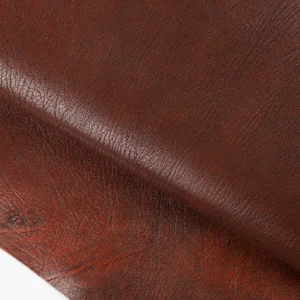
Chevre PatNat is naked veg-tan goatskin, thin and light yet tough, developing patina over time with use. Identification, drawbacks, and recommended projects — view hides at Kit Leather.
Chevre PatNat leather is struck-through vegetable-tanned goatskin with an aniline finish featuring black patina in the crevices of its natural, deeply shrunk wrinkles — thin, lightweight, yet tough thanks to tightly intertwined goat fibers. A leather line from Alran tannery (France, founded in 1903, specializing in goatskin), it solves a problem cowhide cannot: thin yet still developing a patina. Suitable for slim wallets and linings.
How to identify Chevre PatNat leather
To the touch, the natural aniline surface feels slightly textured and warm in hand, not smooth and glossy like coated leather. Looking closely, you can see natural, deeply shrunk wrinkles, not uniform like embossed grain, so each hide is unique. In hand, it feels lighter and thinner than cowhide of the same size, yet remains tough and does not crack when folded back and forth.
Why leather crafters favor Chevre PatNat leather
- Thin yet tough: goat fibers are more tightly intertwined than cowhide of the same thickness, so at just over one millimeter it still handles tension and folding well — repeatedly folded without cracking.
- Folds in multiple layers without bulk: wallet corners with multiple slots stack four to six layers of leather; because goatskin is thin, that area stays flat and pliable, allowing the wallet to close tight — where 1.6 mm cowhide would bulge.
- Develops patina over time: vegetable-tanned and aniline-finished, the leather absorbs hand oils, gradually darkening and developing a sheen where frequently touched, giving each wallet a distinct character.
Drawbacks of Chevre PatNat leather
PatNat is thin and soft, so it does not hold structure: items requiring sharp edges or a boxy shape cannot be held by this leather, leaving another leather line to handle the outer shell — if you want a boxy shape, see Epsom leather. The edges are also difficult to burnish round because the edge profile is too thin, so many makers fold or bind the edges instead of burnishing them. Because the leather has an aniline finish, water droplets will leave water stains.
How does Chevre PatNat differ from Chevre Sully and Sully Tuning?
Both are Alran goatskins, both thin and tough — differing in tanning method and color behavior. Compared to Chevre Sully leather (semi-vegetable): Sully feels softer, is less prone to water rings, and keeps its color virtually unchanged; PatNat has an aniline finish, so the surface looks more natural and patinas distinctly. Compared to Sully Tuning leather: Tuning has a shimmering pigment layer that shifts color depending on the angle of light, with the same thickness of about 1.1–1.3 mm as Sully. Choose PatNat if you want to see the leather evolve over time; choose the two Sully lines if you want it to stay as it was when purchased.
What to make with Chevre PatNat leather?
Best suited for slim everyday carry items so the leather patinas in time: slim wallets, cardholders matching its strong suit of thin, tough, and patinating; linings and inner pockets for items with thick cowhide or calfskin exteriors; and soft notebook covers.
Is PatNat goatskin durable despite being so thin?
Yes. Thin does not mean weak: what determines durability is the fiber structure, and goat fibers are tightly intertwined, so they handle tension and folding better than their appearance suggests. A PatNat wallet opened and closed daily for years will not split along the fold. Thin leather only keeps the item from holding a rigid shape; it does not make it wear out quickly.
Does Chevre PatNat leather develop a patina?
Yes, and more noticeably than the Sully goatskin lines. Because it is vegetable-tanned and aniline-finished, the leather surface absorbs hand oils, gradually darkening and gaining a sheen where frequently touched. The speed depends on frequency of use, hand perspiration, and the original color of the hide.
Choosing & buying Chevre PatNat leather at Kit Leather
Kit sells Chevre PatNat leather by the hide — each hide is unique, allowing you to see the exact area, thickness, color, and price of that specific hide. To buy Chevre PatNat leather, click View available Chevre PatNat hides → to select a hide, or message us on Zalo for advice on choosing a hide suited to your project.