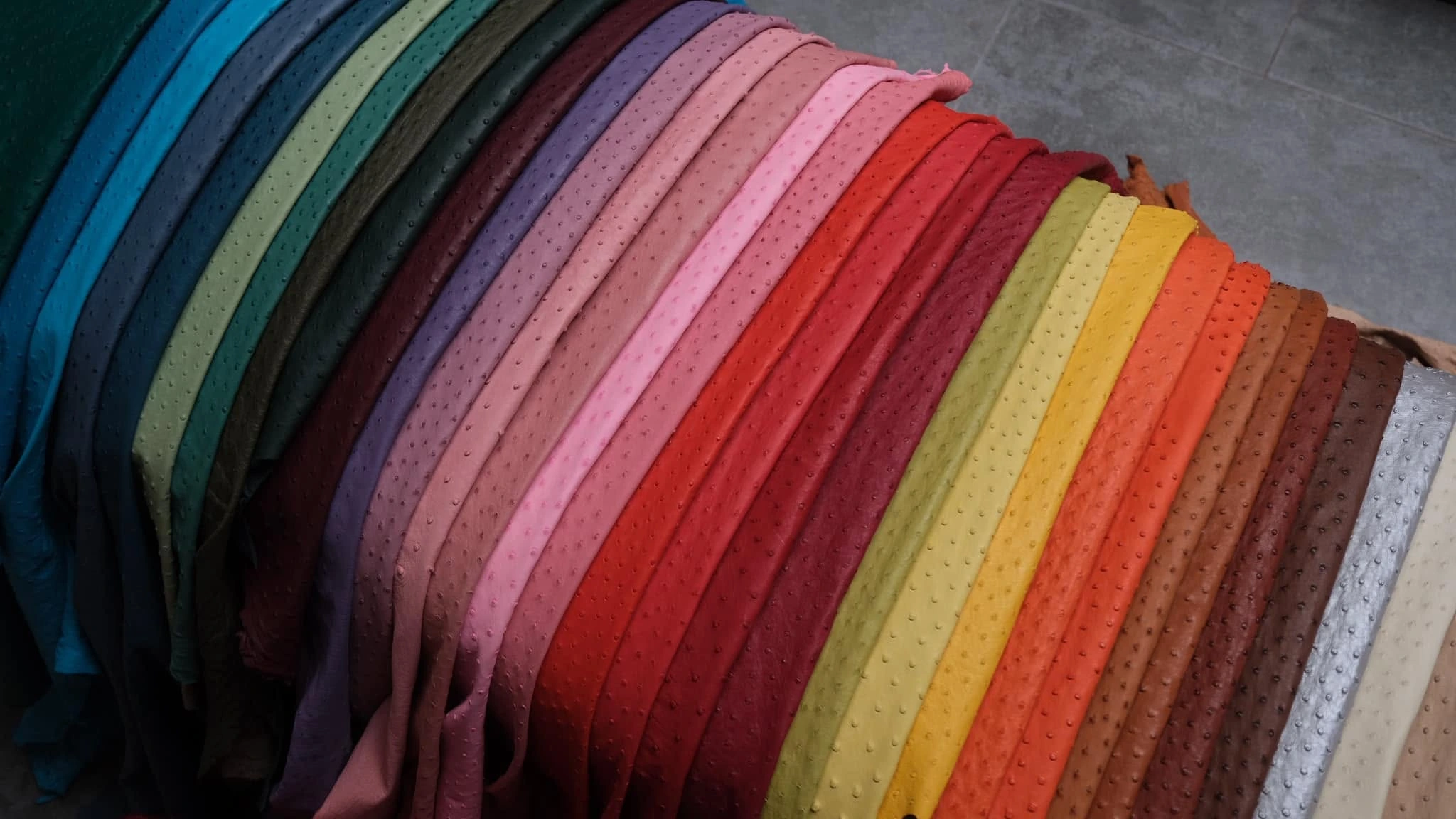
🇿🇦 Leather from South Africa
South Africa is the world's oldest producer of farmed ostrich leather; the ostrich leather in stock comes from the Klein Karoo region.
What South African leather is in stock
South Africa is the world's oldest producer of farmed ostrich leather. The ostrich leather in stock comes from the Klein Karoo tannery in the Klein Karoo region—the country's traditional ostrich farming heartland. The entire South African selection in stock boils down to one leather line: Ostrich.
How ostrich leather differs from cowhide
The immediate visual difference is the raised round bumps on the surface. These are quill follicles where feathers grew. Quills are densest in the center of the back; the neck and belly have smaller or sparser quills; only the area under the wings is smooth.
The practical consequence: you have to plan where you want the quills to sit on the finished product before cutting, and a single hide yields only a limited number of quilled panels. Cut in the wrong spot and you end up with genuine ostrich leather whose front face is plain and smooth—completely missing the feature people chose it for.
The second difference is invisible: durability. Ostrich leather is soft and supple but far tougher than it feels in hand, unlike most other soft leathers where you have to choose between softness and durability.
Regarding tannage, our ostrich leather is chrome-tanned, so it is soft and flexible; colorfastness depends on the finish. You choose it for the quill grain and durability.
How to cut ostrich leather without waste
Because quills are densest in the center of the back, before cutting you should test-lay your paper patterns on the hide, shifting them around so the main visible panels fall squarely on the quilled zone. Secondary components like linings, straps, or back panels can be cut from the smooth parts. Doing the opposite wastes the most valuable part of the hide. This is why an ostrich hide yields fewer quilled parts than you might expect, so plan carefully before laying down your blade.
What it is good for
Bags, watch straps, wallets—items where you want an immediately recognizable accent. Because the leather is soft, pieces that need structure will require reinforcement. A well-placed quilled section on a wallet face or bag body is enough to make a statement; you do not need to cover the entire item in quills.
Is ostrich leather durable?
Yes, more durable than it feels in hand. Ostrich leather is soft and supple, which leads many to assume it is delicate, but it ranks among the most durable soft leathers—no compromise between softness and strength like most soft leathers. Its only drawback is that it has no temper of its own, so items requiring a rigid structure must be lined.
What are the round bumps on ostrich leather?
They are quill follicles—the sockets where ostrich feathers grew. Quills are densest in the center of the back; the neck and belly have smaller or sparser quills; only the area under the wings is smooth. This quilled area is precisely what makes ostrich leather recognizable and sought after, so when cutting, ensure it falls on the main visible panels of the item.